
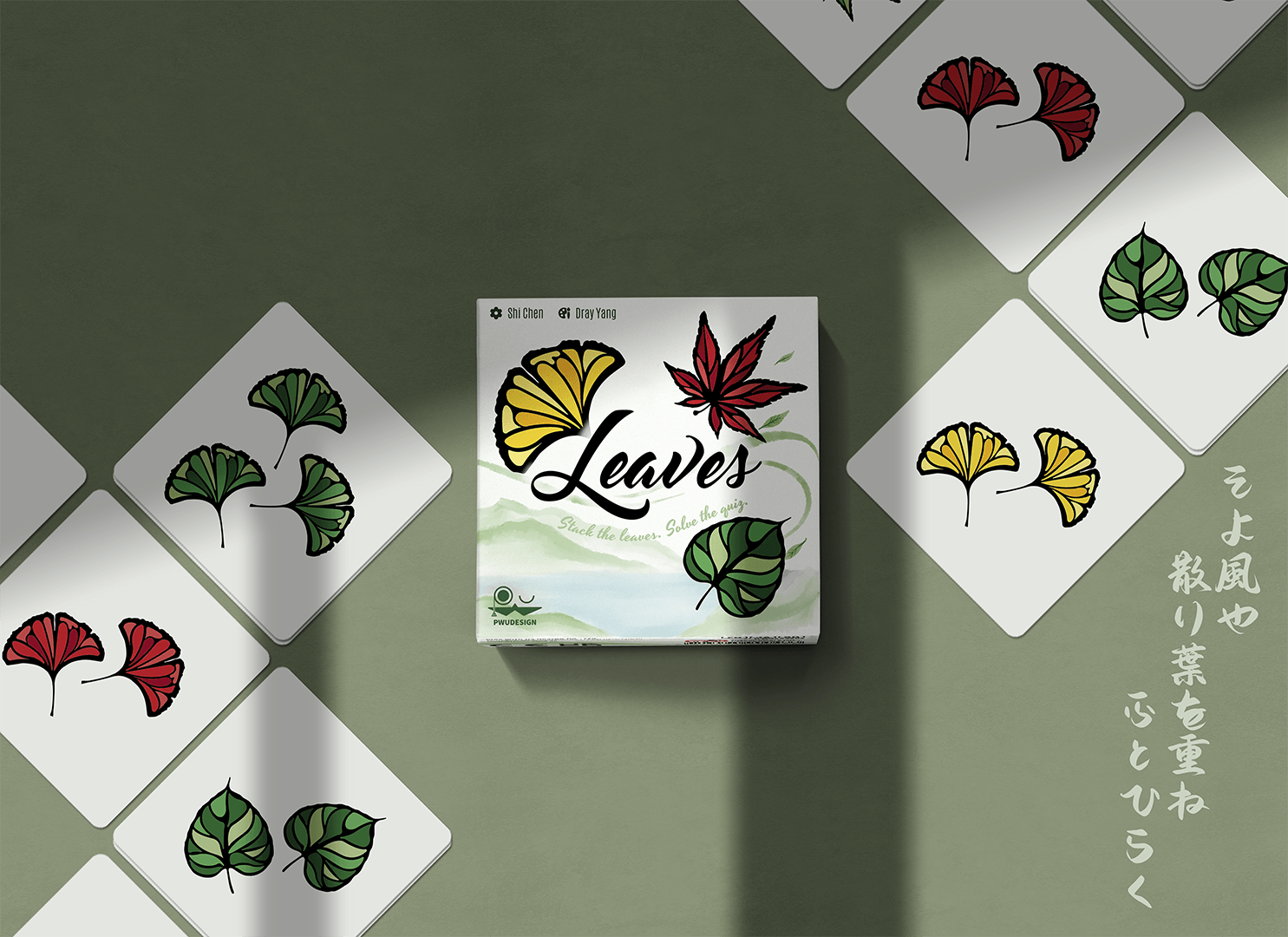
Shi Chen shares how a nine-card prototype grew into a bigger game, then found its way back to the simple puzzle at the heart of Leaves.
An in-house designer’s perspective
Hi, I’m Shi Chen, the lead game designer at Play With Us Design. The team asked me to write about how our games come together, so I’ll be sharing a few stories, some thoughts, and a little behind-the-scenes gossip. If you enjoy these posts, we’d love your support. And if you’re curious about anything to do with board game publishing or development, let us know what you’d like to read about.
First, a little about me. I got into board games in 2010. In 2015, I started Play With Us Design with my colleagues, and that’s how we got into publishing board games. Deck-building is my favorite genre, and I’m less keen on games that rely too heavily on luck. I’ve always wanted to design all sorts of games.
As one of the founders, I spent most of those early days designing and developing games. Over time, most of the projects we took forward came from ideas I’d brought to the team that we thought could become something we could publish.
Working full-time as a designer at a board game publisher seems to be fairly uncommon. A freelance designer typically pitches a game to a publisher. When I have a new idea, I can share it with the team first and get feedback quickly. Maybe it would be too difficult to produce, maybe it’s too close to something already on the market, or maybe it just isn’t fun enough yet or needs a clearer direction.
The team takes a look at my early ideas and prototypes, and together we decide which ones are worth developing and have a shot at becoming published games. Having the team there to help makes design and development go much faster. It also means a game has to do more than play well. We have to figure out how to present it, make its appeal clear to players, and find a place for it in our line-up.
A prototype called Eight Moves
I first came up with Leaves around 2018. It already played much the way it does today, though we had plenty of disagreements during development about what to do with it.
The first question was simple. How do you get people interested in an abstract game when the art can only do so much?
I grabbed some cards from SET to try it out with the team. Yes, you really can play the original prototype with some of the cards from a SET deck. You lay out nine cards face up and use features they have in common to stack them one move at a time, until they’re all in one pile.
It feels a little like SET, Nine Tiles, and Ricochet Robots (for the record, I love all three). You have to recognize the images quickly, compare the features, and work out in your head what sequence of moves might work. That’s also why the artwork has to stay out of the way. If players have to fight their way through the visuals, it’s harder to focus on the puzzle.
A quick aside. The original game took eight moves to stack nine cards into one pile, so I called it Eight Moves, a little nod to Nine Tiles. That was my name for it right up until it became Leaves.
Fun to play, tricky to publish
When I talked it over with our head editor, Dray, I knew who I wanted to make Eight Moves for. I wanted people who liked games like SET and Nine Tiles to feel at home with it. As far as I was concerned, simple, abstract art would do the job. There was no need for an elaborate world around the game.
That got us wondering how a game with minimal artwork, simple rules, and basic components would fare on the market at the time. We’d had a similar conversation while developing Soulaween. Dray’s conclusion was that if we kept all three that simple, the game might have a hard time fitting alongside the rest of our catalogue.
We liked playing Eight Moves. The challenge was turning it into something we felt at home publishing under the Play With Us Design name. We were still looking for a form that would make the game’s appeal clear to players, help it stand out, and make us say, “Yes, that’s what this game should look like.”
So what could I do to make Eight Moves feel at home in the line-up we had at the time?
We tried making it bigger
Everyone on the team liked Eight Moves, so we tried making its central mechanic one of the actions in a bigger game. ST, one of our editors, came up with a lot of versions and some fun settings. The idea was that once you’d stacked all nine cards, you could take one of them as a resource to help you meet a victory objective.
Think of moving orbs around in Puzzle & Dragons. Moving the orbs is the main thing you do, but you’re doing it to make combos so your characters can attack. We tried giving the card-stacking puzzle in Eight Moves a similar role. Solving it would earn you resources you could use for other actions in the game.
That approach certainly gave us room to make the game richer and add more variety.
By the way, this version had a steampunk theme. We even asked the illustrator who’d worked on Soulaween to develop the visual concepts for it. It looked so cool!
Making it bigger showed us why it worked better small
We spent about two months tweaking and testing that version. I eventually realized I was spending too much time setting up challenges, adjusting victory objectives, and figuring out how you’d earn and convert resources. The whole thing felt a little top-heavy when we played it.
Here’s what I mean. The original card-stacking puzzle was a good challenge on its own, and collecting and trading resources to meet a victory objective was appealing in its own right. But once we put them together, I couldn’t see a good reason for the puzzle to be there.
Put simply, the parts we’d added might have been more fun with a different mechanic for earning and converting resources. Eight Moves felt like something we’d squeezed in.
So I told the team straight up that I thought we could take the game in a different direction. I wanted to keep the original mechanic and let players get straight to the part I loved most, the puzzle itself.
That put us right back where we started.
We put it aside and kept thinking about it
We still hadn’t found a way forward, so we stuck to our publishing plan and released Vitamors Conspiro, the sequel to Vita Mors, first. We usually have several projects in development at once, and at the time we had to focus on the releases that needed our attention most.
COVID-19 began spreading around the world in late 2019. Restrictions on in-person gatherings, shop closures, and cancelled conventions hit board games hard. We had to put our energy into figuring out how to keep a party game for five to ten people visible and selling under those conditions.
So we put our plans to publish new games on hold. We only started looking at whether we could make and publish new games again once the pandemic began to ease, restrictions were lifted, and conventions started coming back in different countries.
A little aside. Dray and Yawen kept trying out different art directions during that time, looking for the right way to present Eight Moves. I hear they were even thinking about it in their sleep.
As things opened up again, my tireless efforts (aka telling everyone how much I loved Eight Moves every time I came to work) paid off. We brought it up again when we sat down to plan the year in early 2023, and it finally became one of our main development projects for the year.
I really do love Eight Moves. Over the years, I’ve come to think that the simpler and more refined a game feels, the harder it is to design. Eight Moves gave players the experience I wanted them to have, so I’d always wanted to publish it. And of course, I was sure it would do well, too.
Another game moved to the front of the queue
Remember how I said we usually work on more than one game at a time? In early 2023, while we were still looking for the right theme and artwork for Eight Moves, I had another idea for a game. That idea went on to become the core mechanic of Doodle Puzzle.
We were still hitting a wall with Eight Moves. We were running a little low on ideas, and everything we came up with seemed promising without feeling quite right. ST came right out and said he thought Doodle Puzzle could do well. It needed plenty of testing and tweaking, though, and if we were going to publish it, we’d have to put Eight Moves on hold.
So Doodle Puzzle became our main focus. Whenever we had time left in a meeting, we’d pull Eight Moves back out and brainstorm a little more. It went back on my mental list of games I was determined to find a way to publish.
A new line of games gave us an opening
Doodle Puzzle came out in late 2023. Around that time, Aves, Cheers, and Vita Mors sold out one after another, leaving us with fewer games to put on the shelves at conventions. We started talking about bringing back some of our older games. In the end, we reworked Wonderland XIII and published it as Club of Cthulhu.
After working on that remake, Dray suggested a more affordable line of games. His idea was to give them smaller boxes and lower price points, so they’d have a clear place of their own in our catalogue.
For me, that opened a door.
Back to what worked best
Eight Moves finally had somewhere to go, so there was no pressure to make it bigger or more complicated. It could go back to being simple, clean, and straightforward. You could get straight into it and feel the satisfaction of solving a puzzle within moments of sitting down.
That gave us a way forward again, and Eight Moves began to take shape as Leaves.
Why did we end up with fallen leaves, and what other ideas did we try along the way? I’ll leave that story to someone else who was there.
Back to the journal